 Directly to the content


The fine dust of construction sites, quarries, recycling yards, expressions, cement and steelworks is not only dirty, but also unhealthy for us humans. The small dust particles that arise during demolition work buzz around in the air and are inhaled unnoticed. The result is dust deposits and contaminants within cities. For this reason, it is legally mandatory to bind the dust with the help of water during demolition work. An often seen picture: An employee aims at the point with a water hose that is currently being removed from the excavator next to him. We have found a modern alternative for this: the dust binding machine.
How do dust cup machines work?
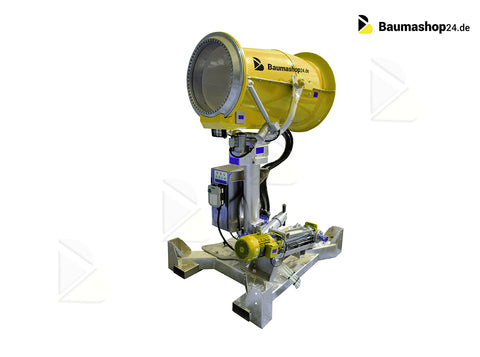
The stamens bind the dirt particles through a comprehensive, fine water jet, which means that the particles fall to the ground.
An important criterion for choosing a suitable dust binding machine is the size of the water drops. Small drops of water are recommended for reliable dust binding. Larger drops (> 1 mm) are used by their mass to bind the dust in such a way that it stays on the ground and do not rise again.
Our stamens are particularly different in the water throw width, the number of nozzles, electricity requirements and pressure.
What are the properties of our stamens?
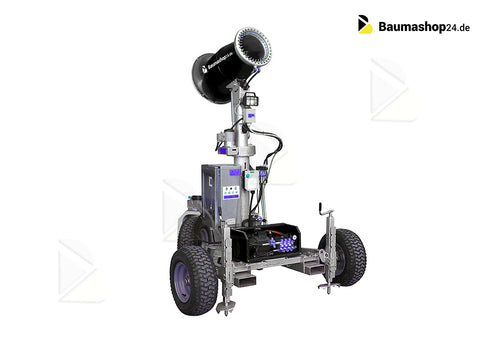
All of our stamens have an integrated storage programmed control (PLC), an automatic swivel angle of 340 °, an automatic inclination level from -20% to +45% and heated aluminum formwork with electrical resistance to ensure functionality at less than 0 °. With each of our dust binding machines, you can optionally acquire a remote control with up to 100m range.
You don't know exactly whether our systems are the right investment for you? Contact us and find out more about the advantages of a dust binding machine for your construction project.